What is Chemical Reaction?
Chemical reaction, a process in which one or more substances, the reactants, are converted to one or more different substances, the products.
A process that involves rearrangement of the molecular or ionic structure of a substance, as distinct from a change in physical form or a nuclear reaction is known as chemical reaction.
- 1 Synthesis Reactions.
- 2 Decomposition Reactions.
- 3 Single Replacement Reactions.
- 4 Double Replacement Reactions.
- 5 Double Displacement Reaction. 5.1 Precipitation. 5.2 Acid-Base Neutralization.
- 6 Combustion.
- 7 Organic Reactions.
- 8 Redox.
1.Synthesis Reaction
What Is a Synthesis Reaction?
A synthesis reaction or direct combination reaction is a type of chemical reaction in which two or more simple substances combine to form a more complex product. The reactants may be elements or compounds. The product is always a compound.
Synthesis reactions, the act of combining two or more substances together to make a product, occur all around us, from the kitchen to our chemical laboratories.
What is a Synthes Reaction?
A cronut and crookie, two very hilarious food terms, they surely took the world by storm when making their grand debut. Did you know those are great examples of products made from a synthesis reaction? It may seem odd to mix a food term with a science term but it is definitely true. Before we discuss how this is so, let's go over what a synthesis reaction is.
A synthesis reaction is the joining together of two reactants, or compounds, to produce a complex product, also called a compound. Sometimes synthesis reactions can result in the formation of more than one product, as we'll see shortly with the process of photosynthesis.
Whether it is one complex product or multiple products, a great way to remember what a synthesis reaction is, is to think of the word 'combination.' Essentially, you are combining reactants to make a desired product. The formula for a synthesis reaction, involving the formation of a complex product, is shown here in Diagram 1. As you can see, substance D combines with substance R to produce a more complex compound, labeled DR.
 As you can gather from the equation shown in Diagram 1, a synthesis reaction is not a multi-step process. That is, there is no need to be concerned with learning multiple steps for this reaction. In fact, a synthesis reaction is perhaps one of the most widely used reactions; not just in chemistry, but also in unconventional places, such as our kitchens.
Before we practice a few examples, there are two concepts to keep in mind regarding synthesis reactions. First, binary compounds can be produced from a synthesis reaction. Abinary compound is a compound that contains only two different elements. For example, the combination of two reactants, iron and oxygen, will produce the binary compound iron oxide, commonly known as rust.
Second, always remember when working with synthesis reactions to balance your equation. As you will see shortly, coefficients, for example numbers, are sometimes required to ensure what is present on the left side of a reaction is equal in amount to what is present on the right side of a reaction. Now that we have addressed these two fundamental concepts, let's apply what we've learned to a few examples.
Synthesis Reactions
| This is the most well-known example of a synthesis reaction—the formation of water via the fusion of hydrogen gas and oxygen gas. | |
| Another example of a synthesis reaction is the formation of sodium chloride (table salt). |


The general form of a synthesis reaction is A + B → AB. Synthesis reactions "put things together".
Because of the very high reactivities of sodium metal and chlorine gas, this reaction releases a tremendous amount of heat and light energy. Recall that atoms release energy as they become stable, and consider the octet rule when determining why this reaction is so favorable
.
Decomposition Reactions
Decomposition Reaction Defined
A chemical reaction is a process by which the atoms of one or more substances are rearranged to form different substances. There are many types of chemical reactions. These reactions are often classified by what they form or what happens during the course of the reaction.
A decomposition reaction is a type of chemical reaction in which a single compound breaks down into two or more elements or new compounds. These reactions often involve an energy source such as heat, light, or electricity that breaks apart the bonds of compounds.
These are the opposite of synthesis reactions, with the format AB → A + B. Decomposition reactions "take things apart". Just as synthesis reactions can only form one product, decomposition reactions can only start with one reactant. Compounds that are unstable will decompose quickly without outside assistance.

| One example is the electrolysis of water (passing water through electrical current) to form hydrogen gas and oxygen gas. | |
| Hydrogen peroxide slowly decomposes into water and oxygen because it is somewhat unstable. The process is sped up by the energy from light, so hydrogen peroxide is stored in dark containers to slow down the decomposition. | |
| Carbonic acid is the carbonation that is dissolved in soda. It decomposes into carbon dioxide and water, which is why an opened drink will lose its fizz. |



Note: Decomposition, aside
from happening spontaneously in unstable compounds, occurs under three
conditions: thermal, electrolytic, and catalytic. Thermal decompositionoccurs when a substance is heated. Electrolytic decomposition, as shown above, is the result of an electric current. Catalytic decomposition happens because a catalyst breaks apart a
substance.
Double Displacement Reaction
This is also called an "exchange". Here are the examples below:
1.) HCl + NaOH ----> NaCl + H2O
Precipitation A precipitation reaction occurs when an ionic substance comes out of solution and forms an insoluble (or slightly soluble) solid. The solid which comes out of solution is called a precipitate. This can occur when two soluble salts (ionic compounds) are mixed and form an insoluble one—the precipitate.
| An example is lead nitrate mixed with potassium iodide, which forms a bright yellow precipitate of lead iodide. | |
| Note that the lead iodide is formed as a solid. The previous equation is written in molecular form, which is not the best way of describing the reaction. Each of the elements really exist in solution as individual ions, not bonded to each other (as in potassium iodide crystals). If we write the above as anionic equation, we get a much better idea of what is actually happening. | |
| Notice the like terms on both sides of the equation. These are called spectator ionsbecause they do not participate in the reaction. They can be ignored, and the net ionic equation is written. |



In the solution, there exists both lead and iodide ions. Because lead iodide is insoluble, they spontaneously crystallise and form the precipitate.
Acid-Base Neutralization
In simple terms, an acid is a substance which can lose a H+ ion (i.e. a proton) and a base is a substance which can accept a proton. When equal amounts of an acid and base react, they neutralize each other, forming species which aren't as acidic or basic.
| For example, when hydrochloric acid and sodium hydroxide react, they form water and sodium chloride (table salt). | |
| Again, we get a clearer picture of what's happening if we write a net ionic equation. |


Acid base reactions often happen in aqueous solution, but they can also occur in the gaseous state. Acids and bases will be discussed in much greater detail in the acids and bases section.
Combustion
Combustion, better known as burning, is the combination of a substance with oxygen. The products are carbon dioxide, water, and possible other waste products. Combustion reactions release large amounts of heat. C3H8, better known as propane, undergoes combustion. The balanced equation is:

Combustion is similar to a decomposition reaction, except that oxygen and heat are required for it to occur. If there is not enough oxygen, the reaction may not occur. Sometimes, with limited oxygen, the reaction will occur, but it produces carbon monoxide (CO) or even soot. In that case, it is called incomplete combustion. If the substances being burned contain atoms other than hydrogen and oxygen, then waste products will also form. Coal is burned for heating and energy purposes, and it contains sulfur. As a result, sulfur dioxide is released, which is a pollutant. Coal with lower sulfur content is more desirable, but more expensive, because it will release less of the sulfur-based pollutants.
Organic Reactions

Organic reactions occur between organic molecules (molecules containing carbon and hydrogen). Since there is a virtually unlimited number of organic molecules, the scope of organic reactions is very large. However, many of the characteristics of organic molecules are determined by functional groups—small groups of atoms that react in predictable ways.
Another key concept in organic reactions is Lewis basicity. Parts of organic molecules can be electrophillic (electron-loving) or nucleophillic (nucleus, or positive loving). Nucleophillic regions have an excess of electrons—they act as Lewis bases—whereas electrophillic areas are electron deficient and act as Lewis acids. The nucleophillic and electrophillic regions attract and react with each other (needless to say, this has inspired many terrible organic chemistry jokes).
Organic reactions are beyond the scope of this book, and are covered in more detail in Organic Chemistry. However, most organic substances can undergo replacement reactions and combustion reactions, as you have already learned.
Redox

Redox is an abbreviation of reduction/oxidation reactions. This is exactly what happens in a redox reaction, one species is reduced and another is oxidized. Reduction involves a gain of electrons and oxidation involves a loss, so a redox reaction is one in which electrons are transferred between species. Reactions where something is "burnt" (burning means being oxidised) are examples of redox reactions, however, oxidation reactions also occur in solution, which is very useful and forms the basis of electrochemistry.
Redox reactions are often written as two half-reactions showing the reduction and oxidation processes separately. These half-reactions are balanced (by multiplying each by a coefficient) and added together to form the full equation. When magnesium is burnt in oxygen, it loses electrons (it is oxidised). Conversely, the oxygen gains electrons from the magnesium (it is reduced).
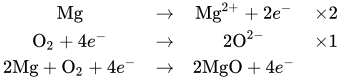
Redox reactions will be discussed in greater detail in the redox section


No comments:
Post a Comment